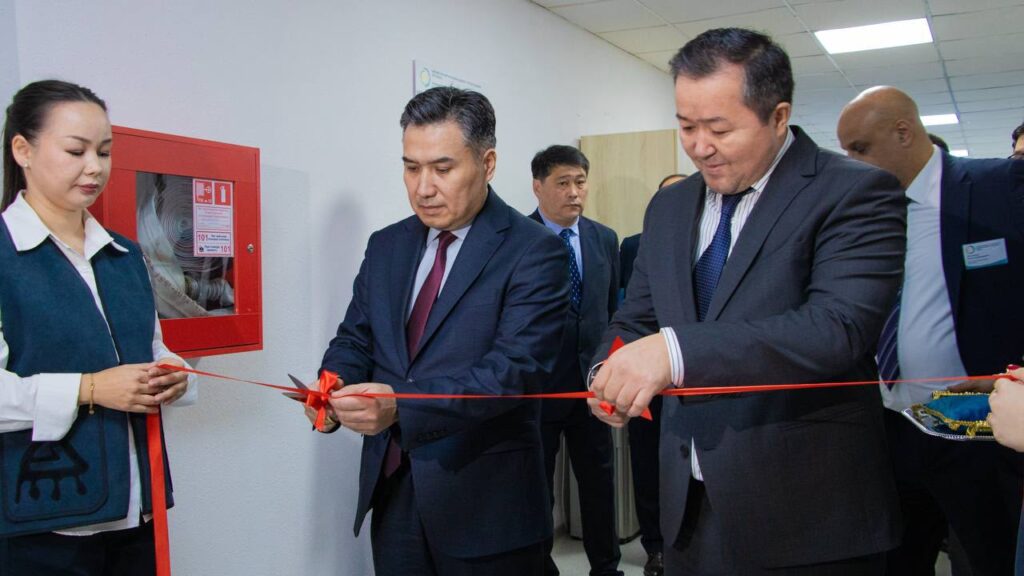
Today, Kazakhstan’s first state laboratory for the design and manufacture of custom orthoses was officially opened in Almaty. The new facility has been established at the National Scientific Centre for the Development of Social Protection of the Ministry of Labour and Social Protection of the Population of the Republic of Kazakhstan and will serve as a modern centre for providing individual prosthetic and orthopaedic care to children and adults.
The laboratory aims to further develop the national rehabilitation system, expand access to modern assistive devices, and introduce digital technologies into their design and production.
The event was attended by Minister of Labour and Social Protection of the Population of the Republic of Kazakhstan Askarbek Yertayev, deputies of the Almaty City Maslikhat, representatives of local executive bodies and public organisations, and specialists in social protection and rehabilitation.
Guests were shown the capabilities of the new laboratory and the full technological cycle of producing a custom orthosis, from the initial assessment and digital 3D scanning to computer modelling, manufacturing, fitting, individual adjustment, and training in the use of the finished device.
A key focus of the laboratory will be early orthotic care for children with musculoskeletal disorders. The project provides for the free manufacture of custom orthoses for children with relevant medical indications. This approach will ensure timely support for each child, taking into account their individual anatomical features and rehabilitation needs.
Commenting on the laboratory’s objectives, Askarbek Yertayev emphasised:
“This is a practical step in implementing the Head of State’s instructions to create equal opportunities for persons with disabilities and to develop an accessible rehabilitation system. This work is also in line with the objectives of the Concept of Inclusive Policy of Kazakhstan for 2025–2030. It is important to us that modern technologies directly help people. That is why the laboratory will be not only a place for manufacturing orthoses, but also a research and practice platform for developing new solutions and studying their effectiveness. Particular attention is being paid to children who require orthotic care for medical reasons. We are consistently developing a system centred on the individual, their abilities, health, and quality of life.”
Orthoses are used to support and stabilise specific parts of the body, correct their position, and maintain essential motor functions. The design of the device, the need for its use, and the wearing regimen are determined by specialists based on the person’s health condition and medical indications.
What sets the new laboratory apart is its use of a digital approach at every key stage of production. After the patient is assessed, the relevant body segment is 3D scanned and a digital model is created from the scan. Specialists then design a custom orthosis using specialised software. The resulting model is sent to production, where the device is manufactured on modern equipment.
The use of digital technologies makes it possible to account for each patient’s anatomical features, improve design accuracy, and ensure an individual approach to the manufacture of assistive devices.
Once the orthosis has been manufactured, specialists carry out fitting and any necessary adjustments, check that the device matches the person’s individual parameters, and provide training on its use. Where necessary, the patient’s digital data can be stored for future design adjustments or for producing a replacement device. Work with patients also includes rehabilitation follow-up.
The laboratory is equipped with modern technological equipment, including a 3D scanner, specialised software, a CNC machine, and equipment for polyurethane processing and thermoforming. At the initial stage, it plans to manufacture custom orthoses for the foot, ankle and knee joints, as well as for the upper and lower limbs. The range of devices will be expanded as production capabilities develop and new technological processes are mastered.
The project provides for a phased increase in the laboratory’s production capacity: 500 custom orthoses are planned for 2026, 1,000 for 2027, and 1,500 for 2028.
The laboratory’s activities will not be limited to manufacturing assistive devices. One of its key areas of work will be the scientific evaluation of orthotic treatment outcomes. The data obtained will be used to improve technologies, enhance the quality of individual patient support, and develop methodological guidelines for specialists.
The establishment of the state laboratory is one of the areas of implementation of six projects of the National Scientific Centre for the Development of Social Protection, aimed at developing rehabilitation, providing citizens with modern assistive devices, and improving special social services.
The new laboratory will serve as a practical platform for introducing modern technologies into the social protection and rehabilitation system, developing national expertise in orthotics, and improving access to custom assistive devices.
The launch of the laboratory also lays the groundwork for the further development of domestic production of custom orthoses, the introduction of digital design, and the accumulation of research and practical experience. In the future, the results achieved may be used to scale up modern orthotic approaches and expand the range of devices available to citizens through the state social protection system.
At the end of the event, guests, representatives of public organisations and specialised institutions, as well as patients and their families, noted the importance of the new laboratory and thanked the specialists for creating modern opportunities to obtain custom assistive devices. In their view, the introduction of digital technologies and an individual approach to manufacturing orthoses will make it possible to provide more targeted and timely assistance to children and adults, and the laboratory itself will become a much-needed facility that will help many people across the country improve the quality and effectiveness of their rehabilitation.
Irina Boginya, mother of nine-year-old Sofia, shared her first impressions of the laboratory.
“We are very happy that this opportunity has become available. When we came to the laboratory, we were warmly welcomed, everything was explained in detail, and we were told how the orthotic process would work. I would like to thank the Ministry and the Government for their attention to children with disabilities and their support for families. Behind such initiatives are the real lives of children and parents, for whom this means a great deal. We hope that as many families as possible will learn about the laboratory and be able to take advantage of this opportunity.”
Anastasiya Baltabekova, mother of 11-year-old Alan, also spoke about the importance of such support for families.
“When you are raising a child with a disability, you are constantly looking for ways to help them and improve their health and quality of life. Rehabilitation involves considerable costs, and not every family can afford the necessary devices. That is why the opening of this laboratory is a great support for parents. Here you can receive the orthosis you need at the state’s expense, made with modern technology. For us, this is a real opportunity to give our child the help they need and take another step forward in their development.”